

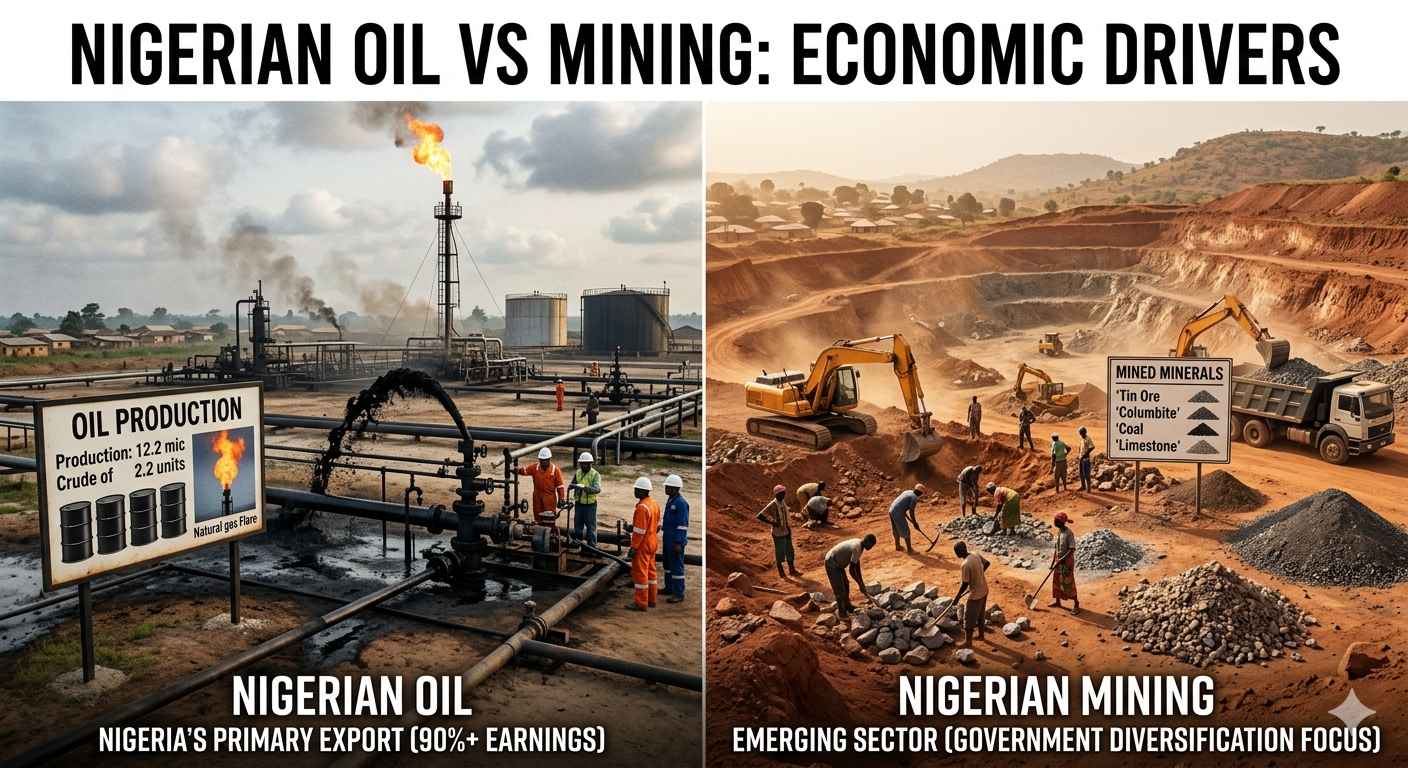
For decades, crude oil shaped Nigeria’s identity.
Oil money built government institutions, funded infrastructure, created billionaires, and became the backbone of the national economy. But while oil brought wealth, it also exposed Nigeria to corruption, economic instability, unemployment, and dangerous dependence on a single resource.
Now, in 2026, another natural resource industry is rising quietly in the background: mining.
Across different parts of Nigeria, investors, governments, foreign companies, and local entrepreneurs are paying closer attention to the country’s vast mineral wealth. Gold, lithium, tin, iron ore, limestone, granite, bitumen, and several other minerals are attracting serious interest.
But beneath the excitement lies a critical question:
Will mining become Nigeria’s next economic breakthrough — or the country’s next major national mistake?
Nigeria’s Forgotten Wealth
Most Nigerians grew up hearing about oil.
Very few people understood that Nigeria is also one of Africa’s most mineral-rich countries.
The nation possesses over 40 commercially viable minerals spread across multiple states. Some of these minerals are essential to industries that power the modern world.
For example:
- Lithium is used in electric vehicle batteries.
- Copper supports electricity transmission.
- Gold remains valuable in finance and technology.
- Limestone drives cement production.
- Iron ore supports steel manufacturing.
- Bitumen can be used for road construction.
- Tin is useful in electronics and industrial manufacturing.
In simple terms, modern civilization depends heavily on minerals.
And Nigeria has plenty of them.
For years, however, the sector remained underdeveloped. Oil dominated government attention while mining operated mostly through informal systems and illegal extraction.
That reality is beginning to change.
Why the World Suddenly Cares About Nigeria’s Minerals
The global economy is changing rapidly.
Countries are moving toward cleaner energy, electric vehicles, renewable technology, and industrial modernization. This shift has created massive global demand for critical minerals.
In 2026, lithium has become one of the world’s most sought-after resources because of its role in rechargeable batteries.
Nigeria possesses commercially viable lithium deposits in states like Nasarawa, Kogi, Ekiti, Kwara, and Kaduna.
This has triggered growing interest from foreign investors and mining companies.
But lithium is only part of the story.
Global demand for solid minerals continues to rise because infrastructure development, manufacturing, technology production, and energy systems all depend on mineral resources.
Nigeria is no longer just viewed as an oil-producing nation.
It is increasingly being viewed as a strategic mineral destination.
The Rise of Mining Communities
In several Nigerian states, mining activities are reshaping local economies.
Communities that once depended mainly on farming are now experiencing increased commercial activities linked to mineral exploration and extraction.
Young people are finding opportunities in:
- Mineral transportation
- Equipment supply
- Artisanal mining
- Site operations
- Security services
- Processing activities
Some local economies are gradually transforming because of mining-related business activity.
But this growth comes with risks.
Without proper regulation, mining communities can quickly become centers of insecurity, exploitation, and environmental destruction.
Nigeria has already seen signs of this danger.
The Dark Side of Illegal Mining
One of the biggest problems facing Nigeria’s mining sector is illegal mining.
Thousands of miners operate outside formal regulation, especially in gold-producing regions.
This creates serious consequences:
- Government loses billions in revenue.
- Armed groups sometimes exploit mining operations.
- Child labor increases.
- Water sources become polluted.
- Farmland gets destroyed.
- Local communities remain poor despite living on valuable land.
In some areas, illegal mining has reportedly contributed to insecurity and violent conflicts.
This is one of the biggest lessons Nigeria must learn from its oil history.
Natural resources can either build nations or destabilize them.
Everything depends on leadership, policy, regulation, and long-term vision.
The Real Wealth Is Not Underground
One of the biggest misconceptions about mining is that minerals alone create prosperity.
They do not.
Many countries possess enormous natural resources yet remain poor because they export raw materials without building industries around them.
The countries that benefit most from mineral wealth usually focus on:
- Processing
- Manufacturing
- Industrialization
- Technology development
- Infrastructure
- Research and innovation
This is where Nigeria’s biggest opportunity truly exists.
Instead of merely exporting raw lithium, Nigeria could eventually build battery manufacturing industries.
Instead of exporting iron ore alone, the country could strengthen steel production.
Instead of depending heavily on imports, local industries could emerge around mineral processing.
That is where sustainable economic transformation happens.
Mining Could Create Millions of Jobs
Nigeria faces a major unemployment challenge, especially among young people.
Mining has the potential to create employment across multiple sectors:
- Engineering
- Transportation
- Construction
- Logistics
- Manufacturing
- Environmental services
- Equipment maintenance
- Industrial processing
Unlike oil, which is highly centralized, mining activities can spread economic opportunities across multiple regions and communities.
This makes the sector particularly important for national development.
However, job creation will only happen at large scale if Nigeria develops proper industrial ecosystems around mining activities.
Simply digging minerals out of the ground is not enough.
The Infrastructure Problem
Mining requires serious infrastructure.
Roads.
Rail systems.
Electricity.
Water supply.
Security.
Ports.
Without these systems, large-scale mining becomes difficult and expensive.
Many mineral-rich areas in Nigeria still lack adequate infrastructure. This discourages investors and slows growth.
Experts believe that improving infrastructure around mining corridors could unlock billions of dollars in economic value.
But infrastructure development requires long-term planning and political commitment.
The Environmental Question
Another major issue is environmental sustainability.
Poor mining practices can damage ecosystems permanently.
Water pollution, land degradation, deforestation, and unsafe waste disposal are already concerns in several mining communities.
If Nigeria fails to regulate environmental standards properly, future generations may inherit damaged lands and public health crises.
Economic growth should not come at the cost of destroying communities and ecosystems.
This balance will become increasingly important as mining expands.
Nigeria’s Next Economic Turning Point
In many ways, Nigeria is standing at another historic crossroads.
Years ago, oil transformed the nation but also exposed deep structural weaknesses in governance and economic planning.
Mining now presents another opportunity.
But opportunities alone do not change nations.
Execution does.
If Nigeria focuses on transparency, industrialization, security, infrastructure, environmental protection, and long-term policy stability, mining could become one of the country’s strongest economic pillars.
But if corruption, illegal operations, weak regulation, and poor planning continue, the sector could repeat many of the same problems seen in the oil industry.
Beneath Nigeria’s soil lies enormous wealth.
The real challenge is whether the country has finally learned how to manage it wisely.
Leave a Reply